
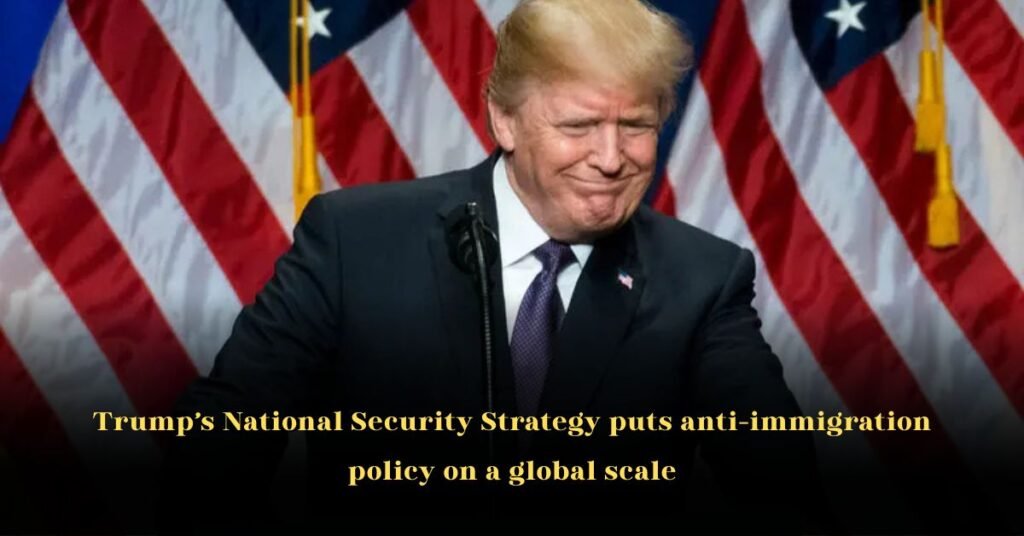
The new security plan from the Donald J. Trump administration is a big and clear change in how America deals with other countries. Before, many people only thought this was the plan, but now it is written down.
The main idea of this new plan is to make U.S. anti-immigration policy a top concern for the whole world, not just for America. This change moves away from the old U.S. goals of working with many nations (multilateralism) and spreading democracy. Now, the main focus is protecting what the administration calls the nation’s and “civilizational” identity.
What the Strategy Says: Framing Migration as a Security Threat
The short plan takes President Trump’s ideas and puts them into a clear structure. It says that controlling who comes into a country is not just about managing borders, but is a key part of his global security plan.
The strategy clearly states that strict immigration control is needed to stop what it calls “hostile foreign influence.” This influence is described in a broad way. It includes things like “human trafficking,” “bad propaganda,” and “cultural subversion.” By connecting border security to the fight against “cultural subversion,” the plan gives a strong reason for aggressive U.S. migration control all over the world. The plan also asks nations to work together to actively block “destabilizing population flows.” This means they want to reduce or stop migration completely if it is seen as a risk, not just control it.
The Broader Vision: Europe and “Civilizational Identity”
The most important part of this new strategy for the world is its focus on Europe’s migration security and the idea of a shared Western “civilizational identity.” The document says a key U.S. interest is to support allies in Europe, but also to help restore Europe’s “self-confidence and Western identity.” The strategy uses very strong words to warn that Europe faces a major problem because of “very low birthrates, and loss of national identities.” It says the continent could become “unrecognizable in 20 years or less.”
The plan uses this worry about who makes up Europe’s population to create a foreign policy goal. It suggests that if some European nations become “majority non-European,” they might start to doubt and weaken old security groups, like NATO. By linking the population makeup of allies to the strength of alliances, the U.S. plan makes Europe’s population security a main concern for the U.S. government. The strategy also gives a positive mention to “patriotic European parties,” showing support for conservative groups across the continent.
ALSO Read: Trump Says European Leaders Are ‘Weak’ in Extraordinary Attack on US Allies
Analysis and Global Implications
The Trump administration’s plan shows a clear move away from past U.S. foreign policy rules. In the past, the U.S. focused on growing democracy and global trade. This new plan, however, makes the preservation of a certain cultural and Western identity in Europe a top goal. Critics say this focus is heavily based on a specific cultural and racial history. Looking at it this way, the plan shows the U.S. no longer sees immigration or many different cultures as just problems at home. Instead, they are seen as major, world-level security and migration problems.
This big change has immediate effects globally. It gives strong reasons for an international push toward anti-immigration policies everywhere. It could increase disagreement over migration, race, and identity around the world. The document openly criticizes the European Union’s structure and its migration policies, which can cause conflict with traditional friends and make working together on issues like the Russia-Ukraine war harder.
This strategy suggests a new time where a nation’s position on international relations migration policy becomes a key measure of partnership. This will change how the U.S. works with allies and rivals. The plan is very clear that a focused “America First,” which also means a strong U.S. economy, is the main reason for all U.S. anti-immigration policy on the global stage.
Disclaimer
The news information presented here is based on available reports and reliable sources regarding the contents and implications of the specified National Security Strategy document. Readers should cross-check updates and official policy details from official government and news outlets.